Tell us about the job
Takes about a minute. No obligation.
Sizing a central AC system for a house in Oconto County starts with what the climate actually asks of the equipment. 119 severe weather events were recorded in Oconto County, Wisconsin between 2015 and 2024. At that rate, severe weather is part of the normal operating environment, and a contractor who ignores it when calculating load and selecting components will leave the system undersized for the conditions it will run in. Duct routing, unit placement, and equipment ratings all get chosen with that operating environment in mind.
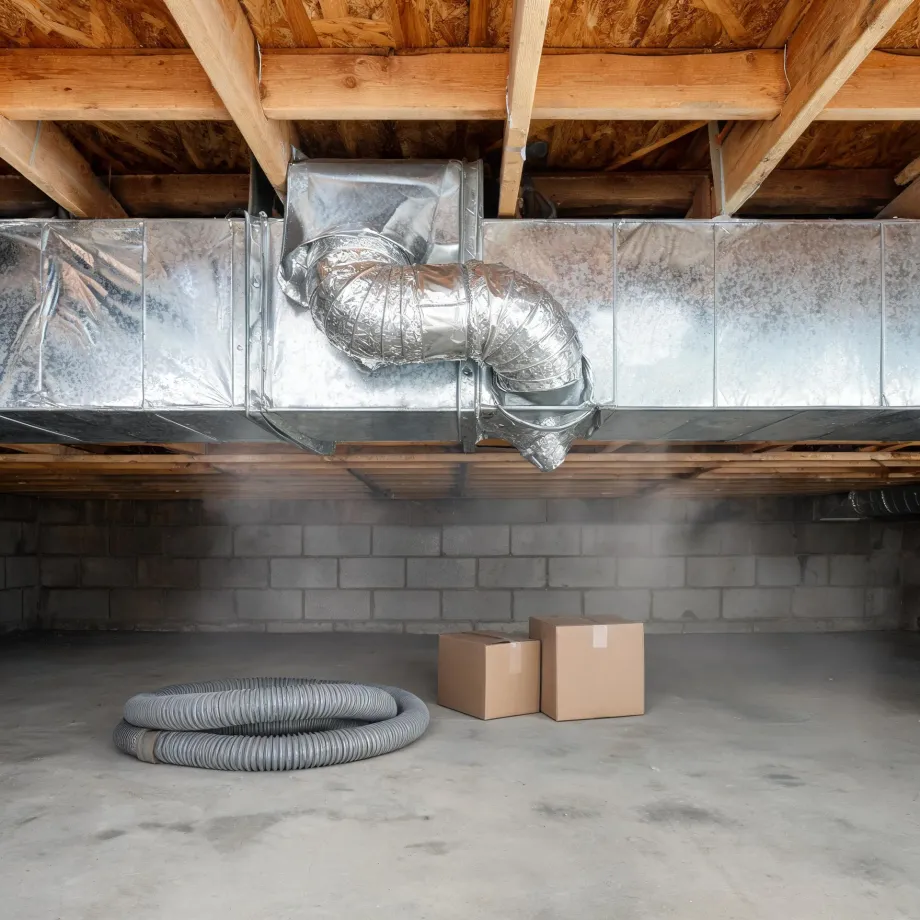
Ductwork designed for a furnace carries air differently than a central AC system needs it to. Half the homes in Oconto County, Wisconsin were built in 1981 or earlier (2020-2024 ACS 5-year). That gap in original purpose is what a contractor works out early in any installation quote here: whether the existing trunk lines and branch runs can move conditioned air to every room without dead spots or pressure problems. If they cannot, the duct work becomes part of the job before the equipment is ever ordered. The electrical service gets the same look, since a new condensing unit draws on circuits that may have been spec'd for something lighter.
What a Central AC System Includes
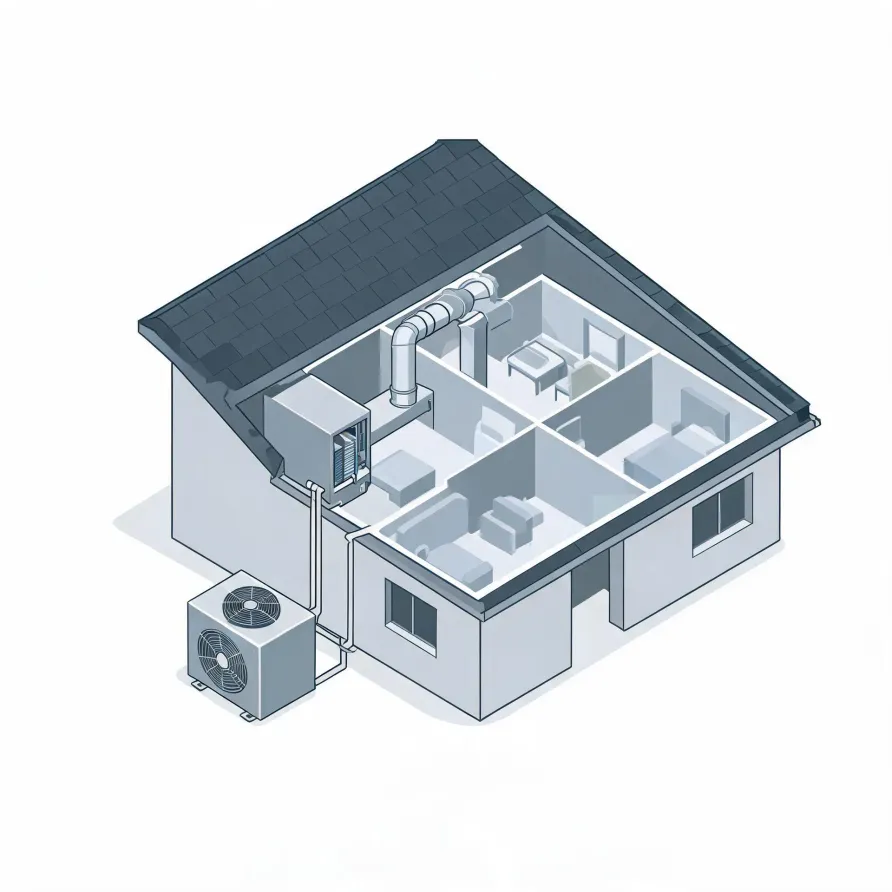
The outdoor condenser unit sits on a concrete pad beside the house and holds the compressor and condenser coil, which are the mechanical core of the system. Inside, the air handler or furnace-mounted evaporator coil sits in a utility space, basement, or closet and is the indoor half of that pair. Together these two units are what a Central AC installation puts in place.
The refrigerant lines run between the outdoor and indoor units, carrying the working fluid that lets the two coils do their job. A thermostat, mounted on a wall in the living space, is what the homeowner touches to set temperatures and signal the system to run.
The drawing shows a typical layout, and a licensed contractor determines what fits this house's specific configuration.
Find a contractor in Oconto CountyOconto County, by the numbers
119 severe weather events were recorded in Oconto County, Wisconsin between 2015 and 2024.
NOAA National Centers for Environmental Information, Storm Events Database, bulk CSV export, events 2015-01-01 through 2024-12-31.Half the homes in Oconto County, Wisconsin were built in 1981 or earlier (2020-2024 ACS 5-year).
U.S. Census Bureau, 2020-2024 American Community Survey 5-Year EstimatesOconto County, Wisconsin holds 24,072 housing units (2020-2024 ACS 5-year).
U.S. Census Bureau, 2020-2024 American Community Survey 5-Year EstimatesOwners occupy 85.0% of the occupied homes in Oconto County, Wisconsin (2020-2024 ACS 5-year).
U.S. Census Bureau, 2020-2024 American Community Survey 5-Year EstimatesCode, Licensing, and Efficiency Rules for Central AC Work in Oconto County, Wisconsin10 sourced rules and standards
What the Installation Actually Looks Like
Split-system central air conditioners rated below 45,000 Btu/h manufactured on or after January 1, 2023 must meet a federal minimum of 13.4 SEER2.
Split-system central air conditioners rated at or above 45,000 Btu/h manufactured on or after January 1, 2023 must meet a federal minimum of 13.4 SEER2.
Split-system central air conditioners manufactured between January 1, 2015 and December 31, 2022 had to meet 13 SEER, the metric that preceded SEER2.
Single-package central air conditioners manufactured on or after January 1, 2023 must meet a federal minimum of 13.4 SEER2.
Space-constrained central air conditioners manufactured on or after January 1, 2023 must meet a federal minimum of 11.7 SEER2.
Federal efficiency standards for split-system central air conditioners and heat pumps are set on each certified combination of outdoor unit and indoor coil rather than on the outdoor unit alone.
Residential and light commercial air conditioning and heat pump systems assembled in the field, including mini-splits and unitary systems, may not be installed on or after January 1, 2025 using a refrigerant with a global warming potential above 700.
A field-assembled system whose specified components were all manufactured or imported before January 1, 2025 carries no installation compliance date under the refrigerant restrictions and may still be installed.
Licensing and Legal Requirements in Oconto County, Wisconsin
A Wisconsin business that employs a certified HVAC qualifier is a certified HVAC business, and no city or county may require it to hold a local certification or licence on top of that.
Wisconsin requires a state HVAC contractor registration: no person or business may install or service heating, ventilating or air conditioning equipment, or offer to, without one.
Severe Weather Events in Oconto County
Weather in this part of Wisconsin puts real demands on cooling equipment. The harder a system has to work through what the climate delivers, the more installation decisions matter.
119 severe weather events, 2015–2024. Source: NOAA National Centers for Environmental Information, Storm Events Database.