Tell us about the job
Takes about a minute. No obligation.
A contractor called out to repair central AC in La Crosse County starts with the components that carry the hardest electrical and mechanical load, because the weather here makes that the right place to look. 195 severe weather events were recorded in La Crosse County, Wisconsin between 2015 and 2024. At that rate, severe weather is a steady feature of life for every system in this area, and the parts that show it first are capacitors, contactors, and compressor windings. A refrigerant leak or a failed blower motor might still be the diagnosis, but the load history here means those high-stress components get checked before anything else on the list.
Half the homes in La Crosse County, Wisconsin were built in 1978 or earlier (2020-2024 ACS 5-year). A central AC system installed into a house of that vintage was put there years after the walls were closed, which means the repair question lands entirely on the equipment itself. Once a contractor opens the unit, what decides the job is whether the failed component is still in production. Compressor models, control boards, and refrigerant-circuit parts cycle out of the supply chain on the manufacturer's schedule. If the part is gone, the repair is gone with it.
The Parts of a Central AC a Contractor Checks First
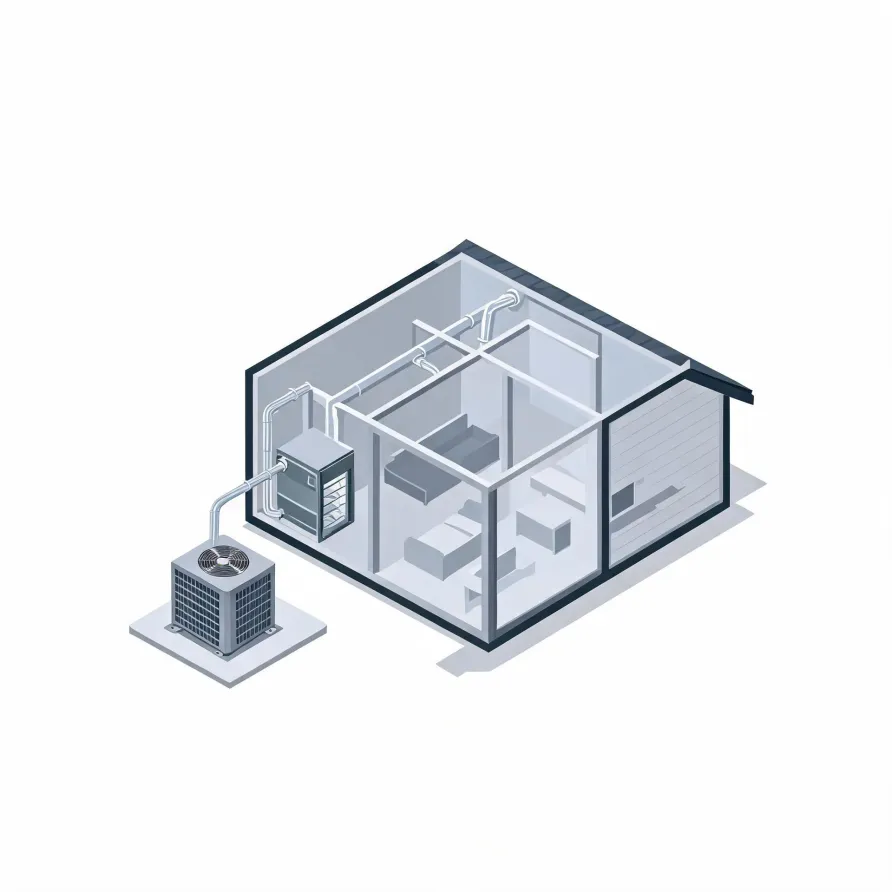
The outdoor condenser unit sits outside the house, usually on a concrete pad along an exterior wall, and it carries the compressor and the condenser coil. These are the pieces a contractor reaches first when the system stops cooling or runs but produces no cold air. A failed compressor, a refrigerant leak, or a seized condenser fan motor will each show up here.
Inside the house, the air handler holds the evaporator coil and the blower. The evaporator coil sits in the airstream where warm indoor air passes over it, and a frozen coil, a dirty coil, or a failing blower motor will all cut airflow or cooling output. The expansion valve and the refrigerant lines that connect the two units are also checked when the system underperforms.
The drawing shows the general layout of a central AC system, and a licensed contractor determines which components apply to your specific house and setup.
Find a contractor in La Crosse CountyLa Crosse County, by the record
195 severe weather events were recorded in La Crosse County, Wisconsin between 2015 and 2024.
NOAA National Centers for Environmental Information, Storm Events Database, bulk CSV export, events 2015-01-01 through 2024-12-31.Half the homes in La Crosse County, Wisconsin were built in 1978 or earlier (2020-2024 ACS 5-year).
U.S. Census Bureau, 2020-2024 American Community Survey 5-Year EstimatesLa Crosse County, Wisconsin holds 54,011 housing units (2020-2024 ACS 5-year).
U.S. Census Bureau, 2020-2024 American Community Survey 5-Year EstimatesOwners occupy 62.2% of the occupied homes in La Crosse County, Wisconsin (2020-2024 ACS 5-year).
U.S. Census Bureau, 2020-2024 American Community Survey 5-Year EstimatesCodes & Standards for Central AC Repair in La Crosse County, Wisconsin10 sourced rules & standards
What HVAC Repair Looks Like in La Crosse County
Split-system central air conditioners rated below 45,000 Btu/h manufactured on or after January 1, 2023 must meet a federal minimum of 13.4 SEER2.
Split-system central air conditioners rated at or above 45,000 Btu/h manufactured on or after January 1, 2023 must meet a federal minimum of 13.4 SEER2.
Split-system central air conditioners manufactured between January 1, 2015 and December 31, 2022 had to meet 13 SEER, the metric that preceded SEER2.
Single-package central air conditioners manufactured on or after January 1, 2023 must meet a federal minimum of 13.4 SEER2.
Space-constrained central air conditioners manufactured on or after January 1, 2023 must meet a federal minimum of 11.7 SEER2.
Federal efficiency standards for split-system central air conditioners and heat pumps are set on each certified combination of outdoor unit and indoor coil rather than on the outdoor unit alone.
Residential and light commercial air conditioning and heat pump systems assembled in the field, including mini-splits and unitary systems, may not be installed on or after January 1, 2025 using a refrigerant with a global warming potential above 700.
A field-assembled system whose specified components were all manufactured or imported before January 1, 2025 carries no installation compliance date under the refrigerant restrictions and may still be installed.
Licensing and Legal Requirements in La Crosse County, Wisconsin
A Wisconsin business that employs a certified HVAC qualifier is a certified HVAC business, and no city or county may require it to hold a local certification or licence on top of that.
Wisconsin requires a state HVAC contractor registration: no person or business may install or service heating, ventilating or air conditioning equipment, or offer to, without one.
Severe Weather Events in La Crosse County
Extreme weather puts AC systems under stress they were not built to absorb continuously. How often that stress hits La Crosse County shapes how hard local equipment works and how quickly repair needs build up.
195 severe weather events, 2015–2024. Source: NOAA National Centers for Environmental Information, Storm Events Database.